5 Quick and Easy Ways to Boost Your Home’s Appeal

If you’re thinking about selling soon you’ll want to take a close look at your home’s condition and determine what projects, if any, will need to be done before marketing it.

Details matter to home buyers but can easily be overlooked by sellers, especially if you’ve been in the home a while. It’s easy to just stop seeing what is always in view. Know that buyer perception will be affected by small, seemingly insignificant improvements. Here’s a list of five simple projects you could do in a weekend to start boosting your home’s appeal for those future buyers.

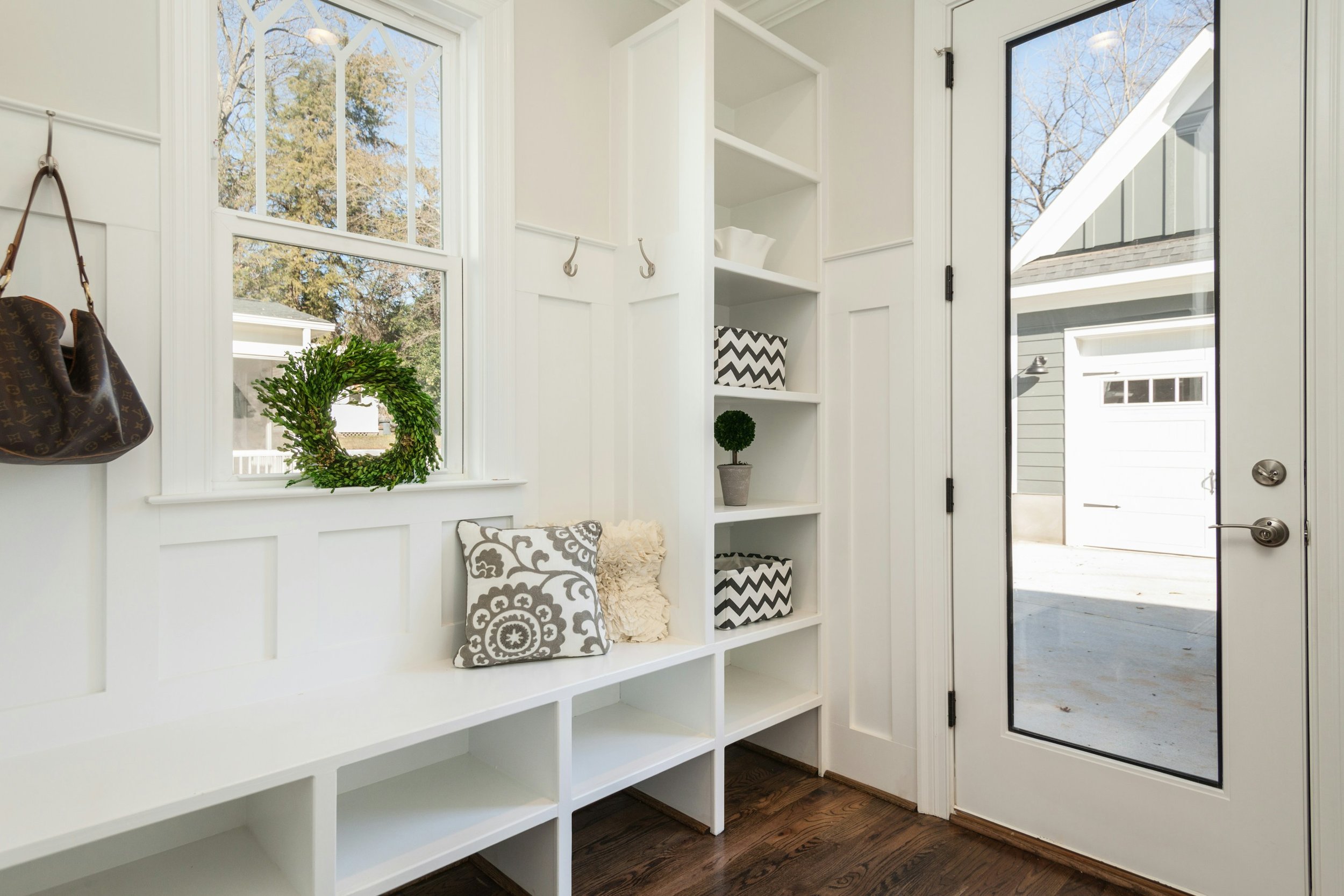
Organize Shoe, Boot, Bag & Coat Storage

Back-Entry.jpg

Winter gear tends to pile up over the season, especially near main entry points. If you list during this time of year, you’ll want to address the mess. Walking into mound of jackets and footwear is a distraction for buyers at the very least, and can easily can create a less-than-ideal first impression for anyone touring your home. Take time to clean it up and create a system for organizing coats, hat, bags and shoes, ideally out of sight. Decorative hooks, baskets, bins or cubbies can work wonders. If you have a coat closet that needs reorganizing, even better. Clean it out and keep it organized. This is something you could do in a weekend. It’s an easy and inexpensive way to boost appeal and create a positive first impression for buyers.

Add Mood Lighting

twin-cities-real-estate-MN-5.jpg

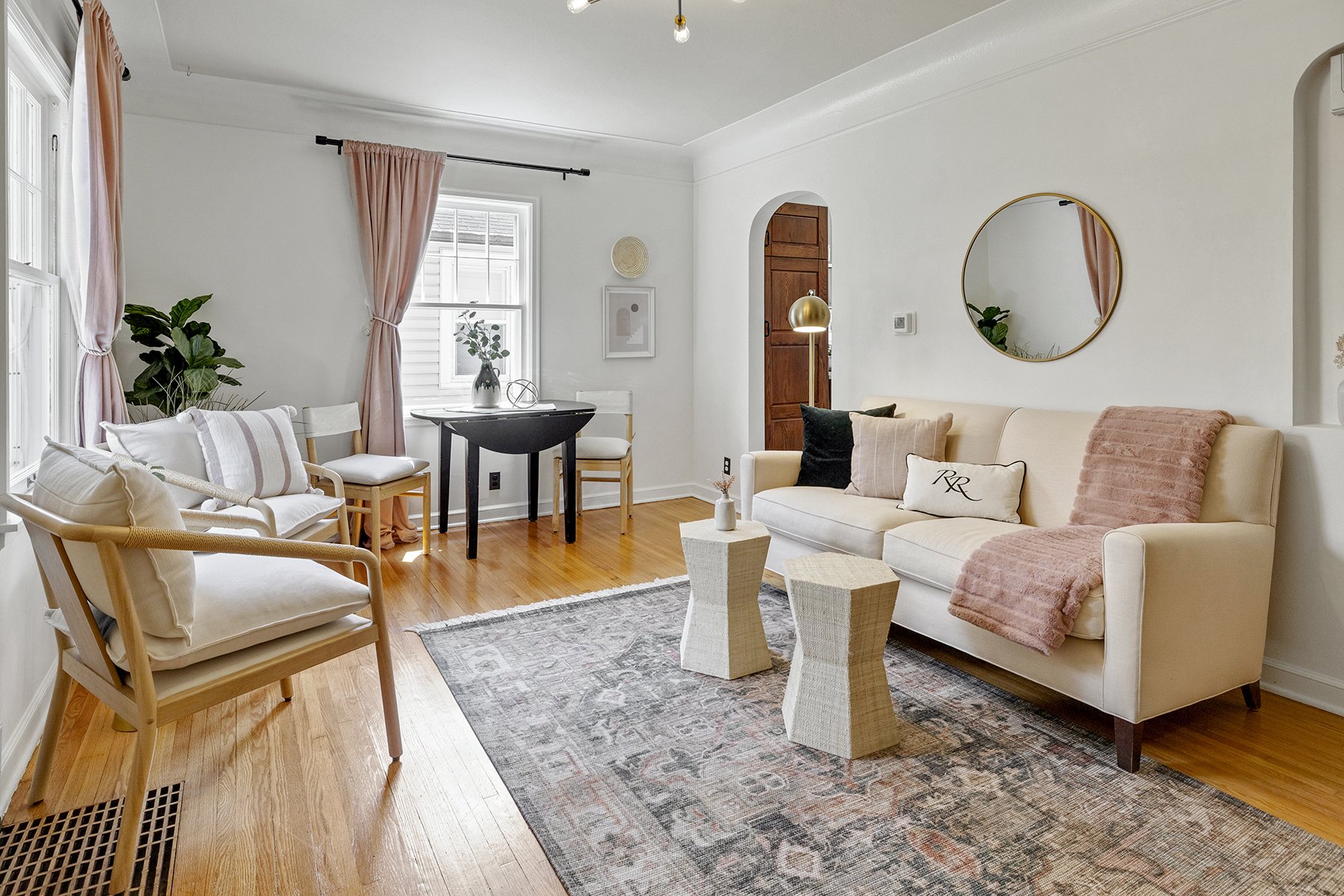
Natural light is always best but this time of year many showings happen after sunset. There’s a good chance buyers will be viewing your home at night, and the light illuminating the space will add to their overall impression. Take a close look at your lighting situation and make the simple additions, repairs or replacements needed to enhance it.

Check all overhead fixtures and sconces for burned out bulbs. Replace where needed and make sure to match bulb strength and color. For example, if you have a 3-bulb bath fixture be sure all three have the same type bulb. And if a fixture is broken, now is a good time to replace it.

Soft, warm light is preferred for creating a cozy atmosphere. Florescent or blue-white bulbs feel cold and harsh. Lamplight also creates a more comforting, homey feel, especially compared to flush mount overhead lights. Add lamps (with warm bulbs) to rooms where space allows. Thinks bedside tables, poorly-lit corners and even bathrooms or hallway console tables. Dimmers on pendants and chandeliers are also handy for creating a cozy ambience. Again, this is an easy, quick way to increase appeal that could be done in a weekend.

Replace Worn Rugs & Welcome Mats

lida-sahafzadeh-UMo3_QxeIRI-unsplash.jpg
jon-tyson-QNkQ5JZPoX4-unsplash.jpg

An even easier project is to get rid of old muddied rugs and welcome mats and replace with new. Clean points of entries are key to creating positive first impressions, and door mats and rugs are usually the first things to come into view. You might want to do this closer to listing though to keep the new ones clean. You could just buy now them and have them ready. One more thing off your list!

Add Potted Plants

twin-cities-real-estate-MN-1.jpg
twin-cities-real-estate-MN-2.JPG
avery-klein-C_dRtsnBOQA-unsplash.jpg

Adding plants to your rooms is a simple and inexpensive way to warm up your space, especially in colder months. House plants add life and can be used as pops of color. Use a floor plant in place of furniture or knick knacks to fill in empty spaces (in big corners, on bookcases, etc.) Add to a bathroom to create a spa-like feel or use as simple centerpieces for a kitchen, dining or coffee table.

Be sure to keep plants looking healthy — trim dead leaves and follow instructions for keeping them alive! If you’re not a plant person you might want to wait until closer to listing before taking on the task. Or pick hardy varieties that demand little attention. Succulents and cacti are easy options. They’re also trendy right now and can add a modern, up-to-date accent that complements most home styles.

Clean!

cleanliness-2799459_1920.jpg
kitchen-3148954_1920.jpg

This may not be quick and simple, depending on your starting point, but it is the most important, and it’s free (or can be). So if there’s anything that needs deep cleaning (refrigerator shelves, bathtub & shower, stovetop, hall closet, garage, etc.) might as well begin now.

When cleaning spaces it’s also best to clean out. Start purging and getting rid of unwanted stuff sooner than later. This part can be overwhelming so go bit by bit and celebrate small completions. Clean kitchens and baths are most noticeable to buyers so you may want to start there.

As the weather warms consider scheduling window washers to clean all windows inside and out (or do it yourself). This will make the whole house seem cleaner. If you’ve never done it, or if it has been a while, you will be amazed, especially after a Minnesota winter or two. And if hiring whole-house cleaners is in your budget, do it. Try to schedule it as close to listing time as possible though.

Learn more about selling

Heidi Swanson is a Realtor® based in St. Paul, Minnesota. She writes a blog to share information on variety of topics including buying and selling, market conditions, homeownership trends, local events and more. Reach her at heidi@lyndenrealty.com or 651-503-1540.

This content was created by a human writer and has not been generated by AI.

Photo Credits

Succulent: avery klein on Unsplash | Rugs: Lida Sahafzadeh on Unsplash

Welcome mat: Jon Tyson on Unsplash | Sink: pascalhelmer on Pixaby
We decided to buy a house! How do we get started?

Once you have made the decision to buy — whether you're downsizing, upgrading, relocating, or becoming first-time homeowners — you'll want to take some initial steps to smooth out the process: choose a realtor, get pre-approved and refine your search.

CHOOSE A REALTOR

Real estate agents advocate on behalf of their clients while guiding them through all steps of the home buying process. They can also be valuable resources for finding other licensed professionals including loan officers, inspectors, closers, contractors, and more.

How do you choose a realtor? Start by asking trusted friends and family members. Most often people get connected through referrals. If your friend or family member had a good experience working with someone, you might too. Depending on your process, you may be spending a lot of time with your agent, so choose someone you like and trust. Communication is also key. Your agent should be conscientious about communicating and skilled at using multiple means for connecting with you and other professionals involved in the transaction.

A good agent will be on your side, listening to your needs and wants, advocating, and negotiating for you throughout the process. Choose someone you believe is doing so because they genuinely care about helping you find exactly what you want in the smoothest possible way.

GET PRE-APPROVED

If you want to make an offer on a house (and plan on financing it) you will need to get a pre-approval letter at the very least. Getting pre-approved differs from being pre-qualified in that it requires more than simply applying for a loan. Pre-approval involves an in-depth analysis of your financial background including credit history, employment verification, assets, etc. The process will provide you with a more realistic picture of what your payments and interest rate might be, and help determine in advance how much house you can afford.

Sellers will always favor pre-approved buyers who demonstrate their ability and intent for getting the actual mortgage. A strong pre-approval from a reputable lender is an important piece that will give you an advantage over competing buyers. It's best to get it done ahead of time to avoid a delay when submitting an offer and possibly losing out on the perfect home. 

REFINE YOUR SEARCH

An infinite number of factors can help determine your needs and wants when buying a home. Common considerations include things like schools, commute time, space, walkability, neighborhood preferences and of course price. You may also be deciding between a single-family home or condo/townhouse lifestyle. Make a list of what you're looking for — decide what you can't live without and what could be a deal breaker.

Once you've narrowed your focus and established parameters, you can more efficiently make use of online tools to help with your search. Your agent can also create an automated search using your criteria, enabling you to receive email notifications of new MLS listings as soon as they become active in the database. This is an easy way for home shoppers to access the most accurate and up-to-date new listings, which can be especially useful when competing with other buyers in a hot seller's market. Of course you can perform your own searches on sites like Zillow, but be aware that listings you see may be inaccurate or out-dated. Check with your agent before getting your heart set on a house you find online. Next step after finding homes? Set up a tour!

Get help finding a home

Heidi Swanson is a Realtor® based in St. Paul, Minnesota. She writes a blog to share information on a variety of real estate related topics including buying and selling, market conditions, homeownership trends and more. Reach her at heidi@lyndenrealty.com or 651-503-1540.

This content was created by a human writer and has not been generated or assisted by AI tools.

What do all those listing terms mean?

Like any industry, Real Estate maintains a language of its own, with shorthand jargon and specialized terms used daily by those in the biz. But lingo used by housing professionals can sometimes be confusing when you're shopping for homes. The following list might help — common terms found in Twin Cities home listings, explained in everyday English:

A (Active)

This means the property is on the market, available, and open for offers. (Sellers may have received an offer but have not yet accepted it.)

A,i (Active, Inspection)

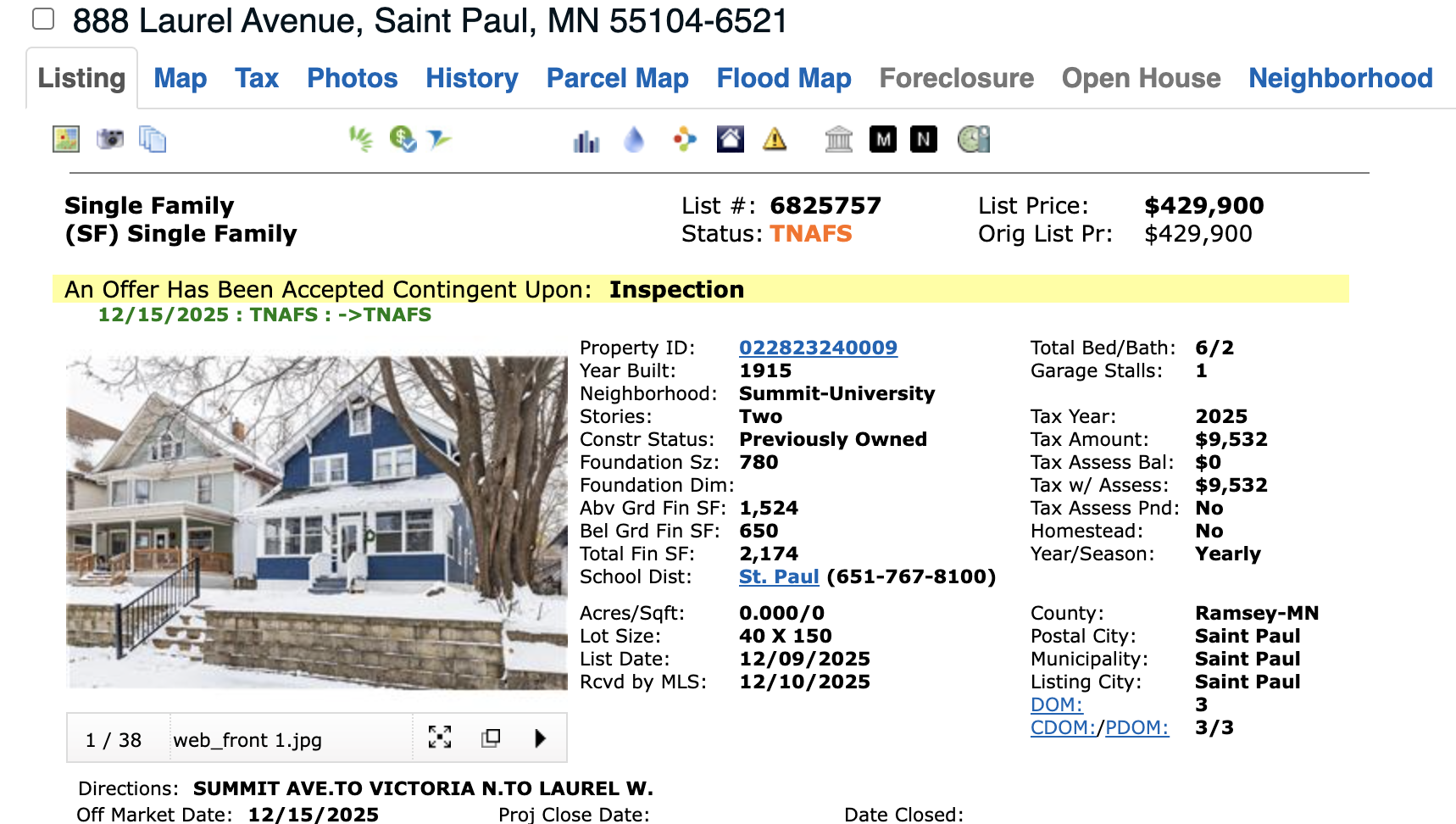
Sellers have accepted an offer contingent on a buyer's inspection of their property. Depending on what's written in the offer, the whole process of inspecting and negotiating repairs, concessions, etc. often takes around 5-10 days.

A,r (Active, Subject to Statutory Rescission)

The sellers of a condo, townhouse or co-op have accepted an offer which is contingent on the buyers reviewing all association governing documents and financials. After receiving the final document, buyers have 10 days to review them in Minnesota. They can cancel the offer at anytime during this period, for any reason.

A,s (Active, Sale of Another Property)

The sellers have accepted an offer from buyers who need (or want) to sell a home in order to buy a new one.

A,o (Active, other)

A,o  means the sellers have accepted an offer with a contingency that could be anything other than the above. For example, if it's a vacant lot and buyers want to get building plans approved by the city before committing, they would submit their offer contingent on the city approval.

P (Pending)

The sellers have accepted an offer and are cruising to closing. This usually means the inspection period has passed and all other contingencies (except financing) have been lifted.

T or TNAFS

This stands for Temporarily Not Available for Showing. It typically means the listing is active but sellers wish to make the property unavailable for private showings, for whatever reason. Maybe they have company staying with them or are making repairs or remodeling. It might also mean they've accepted an offer and are getting a buyer's inspection.

If you are curious about a home with this status, ask your agent to check the MLS database or contact the listing agent directly to get more information. Keep in mind sites like Zillow currently do not display property with TNAFS status.

Coming Soon

The home is visible online but cannot be toured in person until the listed “Active” date. In the Twin Cities Northstar MLS region, listings cannot be “Coming Soon for more than 21 days. They may be open to offers.

Learn more about buying or selling in MN

Heidi Swanson is a Realtor® based in St. Paul, Minnesota. She writes a blog to share information on a variety of real estate related topics including buying and selling, market conditions, homeownership trends and more. Reach her at heidi@lyndenrealty.com or 651-503-1540.

This content was created by a human writer and has not been generated by AI.

Simple Pre-list House Projects

If you’re planning of a home sale in the near future, start prepping sooner than later. Your list of possible tasks can seem overwhelming, so how do you prioritize? Here’s a list of fairly simple and inexpensive projects that will make your home more appealing to potential buyers.

Organize Your Entry

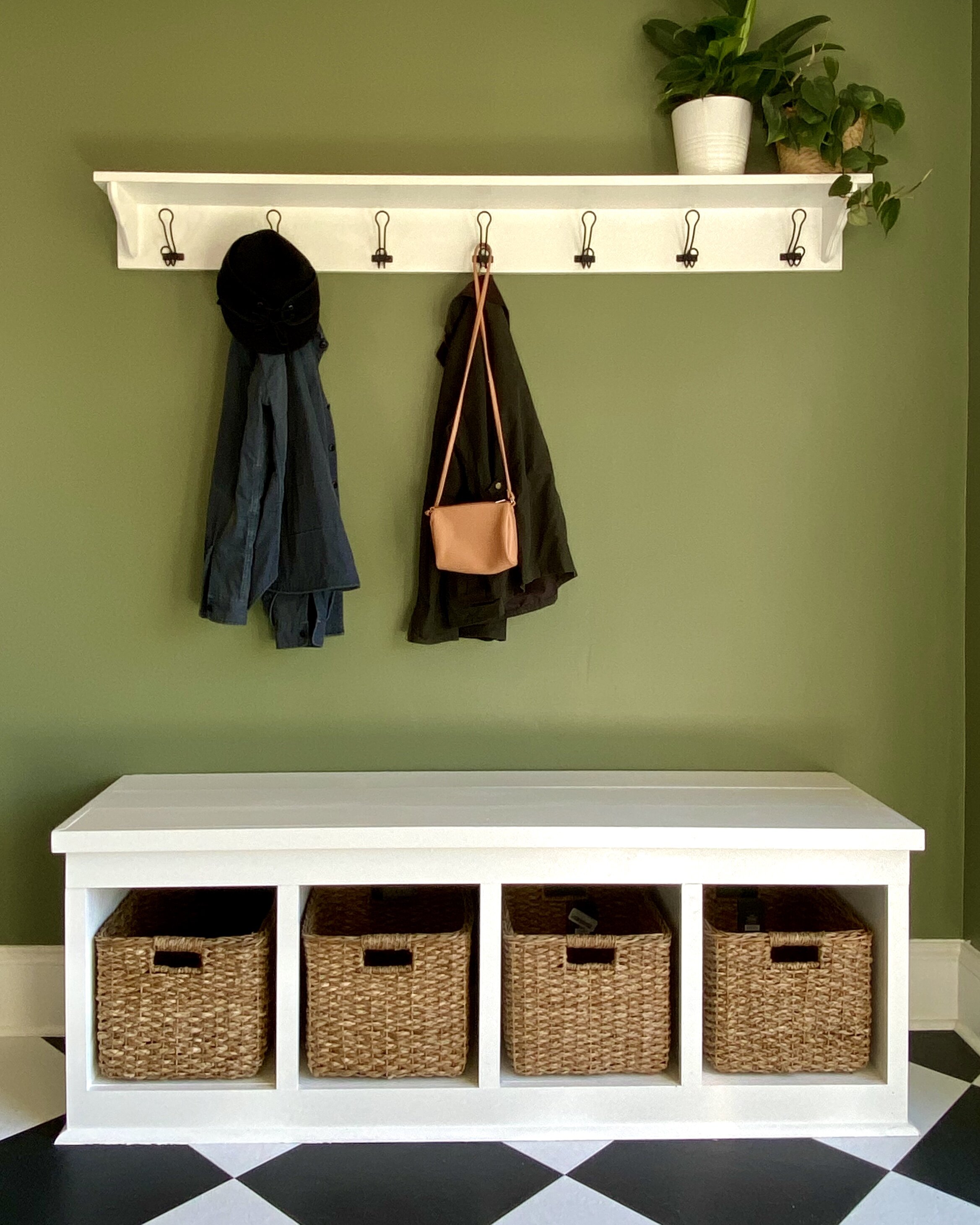
Outdoor gear tends to pile up near main entry points, especially during colder months. Take time to clean it up and create system for organizing coats, hat, bags and shoes, ideally out of sight. Decorative hooks, baskets, bins or cubbies can work wonders. If you have a coat closet, even better. Clean it out and keep it organized. This is something you could do in a weekend. It’s an easy and inexpensive way to boost appeal and create a positive first impression.

IMG_3041.JPG

Purge and Declutter Closets, Drawers, Shelves and Cabinets

This always takes longer than you think. Start now, go room by room, closet by closet, drawer by drawer…or whatever system works best for you.

Replace, Fix, Dispose of Broken Appliances

Broken dishwasher? Replace or fix it. You should have functioning appliances at the very least when selling a home. Old broken freezer in the basement? Remove it. Most buyers don’t want to inherit old appliances they’ll have to pay to dispose of. They may make removal a condition of the sale prior to closing so you might as well do it now. And if a new one is needed, at least you’ll have time to enjoy it.

Fix Leaks or Broken Faucets

This might help your water bill too so you might as well do it now while you’re still living there. If you have a leaky faucet or a running toilet plan on a buyer asking for this repair. If you have loose fitting ones, tighten or replace them now.

Update Cabinet Hardware (Kitchen + Bath Pulls, Knobs, etc.)

This is a cheap way to refresh cabinets. Modernizing hardware, even on outdated cabinets, can make a big difference. Consider coordinating with updated faucets to create a unified look.

clean_garage_home_projects_to_sell_twin_cities_mn.jpg

Clean Out the Garage

Here’s a good spring project. Decluttering your house should be priority when getting ready to sell, but tackle the garage too if you have time.

Repair Holes, Cracks, Water Damage in Walls and Ceilings

Filling holes left from old wall art is cheap and well worth your time. It may require paint touch-ups or even new coats though. Do that too if you can.

Seeing spots from past water damage raises concern for some buyers. Take care to repair them but know you’ll need to disclose in writing any known damage.

Finish Incomplete Paint or Remodel Projects

You may have started a project, stopped it eons ago, and forgotten about it completely. You might not notice it, but a buyer will. Most new owners don’t want to inherit someone else’s half-completed project. Do what you can to finish it off while you have the time.

Clean and Paint Radiators

I love older homes and hot water heat but radiators can become dust-collecting eye-sores if neglected. At the very least, clean them. If time and budget allow repaint them too. Color and paint type matter when finishing radiators so I recommend consulting with experts at a local paint store when selecting products.

Fix Missing Trim, Thresholds, Broken Doors, etc.

Again, like abandoned remodel projects, these can be easily overlooked — you just stop seeing them. Buyers will take note, and may also wonder, “What else has been neglected?

Refresh Outlets and Cover Plates

If you have old, dirty, or mismatched plate covers in rooms, replace them with new matching ones. It’s super cheap, just takes a little time. You also might want to consider grounding outlets and putting GFCIs in all the right places, if you haven’t already.

getting_ready_to_sell_fix_blinds_twin_cities_housing.jpg

Replace or Remove Broken (or Outdated) Window Coverings and Blinds

Think “less is more” when considering your window treatments. People love natural light so let it in whenever possible. Replace broken blinds and shades, or remove them altogether if privacy isn’t a factor. Minimalist coverings are more in vogue. Think plain, airy and simple designs, textures and colors.

Wash Your Windows

Thoroughly clean all windows, inside and out. If you’ve never done it, or if it has been a while, you will be amazed, especially after a Minnesota winter or two. It will make your whole house will feel cleaner. It can be a daunting task depending on your home; hire window cleaners if your budget allows.

Home_Twin_Cities_Real_Estate.jpg
rug_sell_tiwn_cities_real_estate_mn.jpg

Replace Old Rugs and Welcome Mats

Get rid of old muddied rugs and welcome mats and replace with new. Clean points of entries are key to creating positive first impressions, and door mats and rugs are usually the first things buyers see walking in. You might want to do this closer to listing though to keep the new ones clean. You could just buy now them and have them ready. One more thing off your list!

kara-eads-E2hmaK2ZWqw-unsplash.jpg

Add or Transplant House Plants

Adding plants to your rooms is a simple and inexpensive way to warm up your space, especially in colder months. House plants add life and can be used as pops of color. Use a floor plant in place of furniture or knick knacks to fill in empty spaces (in big corners, on bookcases, etc.) Add to a bathroom to create a spa-like feel or use as simple centerpieces for a kitchen, dining or coffee table.

Be sure to keep plants looking healthy — trim dead leaves and follow instructions for keeping them alive! If you’re not a plant person you might want to wait until closer to listing before taking on the task, or pick hardy varieties that demand little attention. Succulents and cacti are easy options that add a modern, up-to-date accent that complements most home styles.

Refrigerator_twin_cities_real_estate.jpg

Deep Clean Everything, Even the Fridge

This may not be so quick and simple, depending on your starting point, but it is the most important, and it’s free (or can be). So if there’s anything that needs deep cleaning (refrigerator shelves, bathtub & shower, stovetop, hall closet, garage, etc.) might as well begin now.

When cleaning spaces it’s also best to clean out. Start purging and getting rid of unwanted stuff sooner than later. This part can be overwhelming so go bit by bit and celebrate small completions. Clean and tidy kitchens and baths are most noticeable to buyers so you may want to start there.

Fix Lights and Replace Bulbs

Natural light is always best but sometimes showings happen after sunset. There’s a good chance buyers will be viewing your home at night, especially in winter months. Pleasant lighting will add to a buyer’s overall impression of a space. Take a close look at your lighting situation and make the simple additions, repairs or replacements needed to enhance it.

Check all overhead fixtures and sconces for burned out bulbs. Replace where needed and make sure to match bulb strength and color. For example, if you have a 3-bulb bath fixture be sure all three have the same type bulb. And if a fixture is broken, now is a good time to replace it.

Soft, warm light is preferred for creating a cozy atmosphere. Florescent or blue-white bulbs feel cold and harsh. Lamplight also creates a more comforting, homey feel, especially compared to flush mount overhead lights. Add lamps (with warm bulbs) to rooms where space allows. Thinks bedside tables, poorly-lit corners and even bathrooms or hallway console tables. Dimmers on pendants and chandeliers are also handy for creating a cozy ambience. Again, this is an easy, quick way to increase appeal that could be done in a weekend.

1389_house_numbers_tin_cities_real_estate.jpg

Spruce Up Your Entry with New House Numbers

This simple change can add instant style and curb appeal. Make sure the font matches your home’s style.

Paint or Touch up Exterior Trim, Siding and Doors

If you have flaking paint, scrape and repaint if possible. If your exterior door needs a refresh, paint it. A pop of color and an inviting entry create curb appeal and positive first impressions. I recommend a statement color in keeping with the style of your home.

Though April is usually too early in Minnesota for outdoor painting, it may be a good time to start planning and scheduling a future project. Martey Jakel, local St. Paul-based painter and owner of Showcase Home Painting takes outdoor jobs all spring, summer and fall, as long as paint can properly adhere. Most paint can be applied with temps and drying time as low as the high 30’s (40 to be safe). Martey recommends doubling the manufacture’s drying time at these temps to ensure adhesion. He also recommends checking window sills and seals where built-up moisture can cause flaking and rot. Caulking and priming these trouble spots before winter can be well worth your time and effort. If you’re not sure how to identify what needs what, call a paint professional. You’ll have better luck scheduling them this time of year as construction and repair projects slow with seasonal changes.

Clean Gutters and Repair Downspouts

Use warmer, rain-free days to do a spring cleaning of gutters. Repair and reposition broken or leaking downspouts to divert rainwater and melting snow.

Repair Rotting Exterior Trim Pieces and Decking

If you have rotting boards, replace them, especially floor boards that can create hazards or let in moisture. If weather permits, paint or stain replaced parts. If you need to hire someone to do the repairs, start calling now to get scheduled. Contractors’ calendars fill up fast this time of year.

mulch_sell_twin_cities_homes_mn.jpg

Add Mulch to Gardens and Landscape

Get ahead of the weeds and spruce up your yard by laying mulch early spring. Avoid bags of plastic by using recycled wood from around the Twin Cities. Many counties and cities offer free wood chips/mulch for pick-up. Ramsey County and the City of Minneapolis have several pick-up sites around the metro, for example. Check your city/county websites for availability, locations and hours.

Get Help

Your home’s condition and age matter when prioritizing your to-do list. These projects may be totally irrelevant or just a starting point, it all depends. If you are considering selling, I recommend getting help creating a customized list before you begin. Walking through your house with a second set of eyes is often what’s needed to zero in on the best use of your time and money. I do this often with clients, sometimes long before listing. If you need help figuring out where to start, call or message me for a consultation. We can even schedule a virtual walk-through to practice safe distancing — whatever works for you.

651-503-1540 | heidi@lyndenrealty.com


Learn more

Heidi Swanson is a Realtor® based in St. Paul, Minnesota. She writes a blog to share information on variety of topics including buying and selling, market conditions, homeownership trends, local events and more. Reach her at heidi@lyndenrealty.com or 651-503-1540. 

This content was created by a human writer and has not been generated by AI.

Changes to the Real Estate Industry in August 2024: NAR Settlement Terms Explained

If you are in the market to buy or sell and have not yet heard about changes coming to the real estate industry later this summer, you will. Hopefully this post will get you started. 

Background

In March 2024, the National Association of Realtors (NAR) agreed to settlement terms which will modify home buying and selling practices for many consumers across the county, including in Minnesota. This post summarizes two key terms from the settlement that will go into effect starting August 15th in the Twin Cities MLS region (no later than August 17th nationwide).

How have real estate agents typically gotten paid for their services?

sellers

Most sellers’ agents do commission-based work with the commission being a percentage of the final sale price. (Other models such as flat-rate exist but for the purpose of this post I’ll use the commission model.) The final payment for services happens at closing. Then, if sellers have agreed, their agent pays a portion of that commission to their buyer’s agent.

buyers

In Minnesota, buyers wishing to be represented sign a Buyer Representation Agreement with an agent detailing services and associated fees (we’ve been using buyer agreements since 1993.) Through the traditional model, most buyer’s agents receive payment for their services via the commission split described above, if the seller agrees. If a seller does not agree to pay the buyer’s agent fees, the buyer would pay the amount they negotiated with their agent in the Buyer Rep. Agreement.

The commission and offers of compensation to buyers’ agents have always been negotiable terms in Minnesota’s representation contracts, and still will be.

The amount a seller agrees to offer a buyer’s agent has historically been visible to other agents in our Multiple Listing Service (MLS). Starting August 15, 2024 it will no longer be.

Two Big Changes Affecting Buyers and Sellers

First Change: Offers of Compensation

“Compensation offers moved off MLS: NAR has agreed to put in place a new rule prohibiting offers of compensation on an MLS. Offers of compensation could continue to be an option consumers can pursue off-MLS through negotiation and consultation with real estate professionals. And sellers can offer buyer concessions on an MLS (for example—concessions for buyer closing costs). This change will go into effect August 17, 2024.” -NAR website

What does this mean?

Offers of compensation to buyers’ agents will still be allowed in Minnesota but they may no longer be advertised on the MLS or any MLS-related aggregator. Listing agents can, however, advertise them off-MLS via individual marketing materials — signs, flyers, individual websites, etc.

Concessions

Buyers have always been able to ask sellers for various types of concessions when making an offer. For example, a buyer might ask a seller for an allowance to buy new carpeting, pay part of their closing costs, or give credit for a new roof. Compensation to pay the buyer’s broker for real estate services may be presented as another type of concession in the offer.

Sellers have always been allowed to offer concessions as incentives to buyers, and still will be able to. The new rule specifically regulates visibility of any offer of compensation to a buyer’s agent for real estate services — it will be prohibited on the MLS. Concessions, such as those listed above, will still be allowed on the MLS.

This change will likely add an extra layer of negotiation, particularly around how agent compensation is handled. There may be bumps in the road but with clear communication and transparency, the process should smooth out to benefit both buyers and sellers.

Second Change: Buyer Representation Agreements

“Written agreements for MLS Participants acting for buyers: While NAR has been advocating for the use of written agreements for years, in this settlement we have agreed to require MLS Participants working with buyers to enter into written agreements with their buyers before touring a home. This change will go into effect August 17, 2024.” -NAR website

What does this mean?

If buyers wish to tour a home with an agent they must first enter into some type of written agreement. In Minnesota we’ve had Buyer Representation Agreements in use for decades. Requiring a signed agreement prior to touring a home, however, will be a new practice starting August 15. New types of touring agreements may come into play which could include various tour fees for buyers.

The new regulation applies to both in-person and virtual visits, but not to open houses. Home shoppers will not need a signed written agreement when visiting open houses or asking host agents about their services.

Differences Among States

NAR as a national trade group includes members from every state. Each state has varying practices and/or legislation that determine how its industry functions; some states may be more affected by the settlement changes, some less. 

Learn More

Real estate professionals in Minnesota have been busy working out a new normal and preparing for August 15th. Both the state and national associations of REALTORS® have published helpful resources for consumers wanting to understand more about the settlement and how changes may affect them. Click here to learn more from our state association or check out NAR’s resources for both buyers and sellers. As the changes get underway don’t hesitate to reach out. I’ll gladly talk through “what if” questions and clarify any new information as it becomes available.


Heidi Swanson is a Realtor® based in St. Paul, Minnesota. She writes to inform buyers and sellers on variety of topics including market conditions, tips for selling and buying, homeownership trends, and more.

This content was created by a human writer and has not been generated by AI.

Thriving in a Seller's Market: Tactical Tips for Homebuyers

If you are a home buyer navigating a fast-paced seller's market, you might feel overwhelmed. With limited inventory and fierce competition it’s easy to find yourself engaged in bidding wars ending in heartbreak. This post is for you dear buyers — with strategies, flexibility, and professional guidance you can turn the odds in your favor and secure your just-right home. 

Tip #1: Get Your Finances in Order

Before you even start your home search, you need to get pre-approved for a mortgage. This gives you a clear understanding of your budget and what you can afford, and signals to sellers you're a serious buyer. It strengthens your negotiating position and allows you to act quickly when the perfect property comes along. Keep in mind, most sellers won’t even look at offers without a lender’s pre-approval.

If you are paying in cash, be prepared to provide proof of funds in lieu of a pre-approval. A bank statement or letter from your banker showing the full amount should suffice. 

When representing sellers, I typically reach out to the buyer’s lender or banker for confirmation of finances before my clients sign anything. Assume your seller’s agent will do the same. 

Tip #2: Work with an Experienced Real Estate Agent

Partnering with a seasoned real estate agent can be crucial in a seller’s market. Your agent should have insider knowledge of the local market, an understanding of current trends in the region, and negotiation skills to help you secure the best deal. Lean on their expertise to navigate a competitive landscape and present an offer with winning price and terms. 

A knowledgeable agent will also have an in-depth knowledge of contracts to help you understand the plethora of paperwork needed for a successful transaction. Read all forms before signing anything, and ask your agent when in doubt. All questions are good ones! 

Tip #3: Be Prepared to Act Fast

In a competitive market, time is of the essence. When you find a property that checks all the boxes, don't wait – schedule a showing as soon as possible. When you’re ready to act, your agent should be connecting with that seller’s agent immediately to establish a relationship, learn seller preferences and gauge the competition. In a multiple offer situation there typically will be an offer deadline. But be aware, ultimately it’s the sellers’ decision — they may be pleased enough with the first offer to just sign it and move on.

Tip #4: Make a Strong and Compelling Offer

If you’re facing competition, put your best foot forward with price and terms. Consider terms favorable to the sellers such as a preferred closing date, appraisal gap coverage or even an inspection contingency waiver, if you're comfortable doing so. And of course, price matters. Sellers will be calculating their net proceeds, which means offer price minus any concessions you may ask for, including paying your realtor fees. Be sure to check in with your lender to stay within your budget and confirm what they can accomplish within the offer timeline.

A Word on “love letters” to the seller

Buyers often ask if they should include a letter to the seller with their offer. My answer is “it depends”. I recommend either avoiding the letter altogether, or including only what you love about the home — no personal information or photos. Getting too personal or including photos could set up the seller for a potential fair housing violation. For example, sellers could unconsciously (or consciously) choose a buyer based on race, religion, familial status, etc. Some sellers explicitly ask for no letters often for this reason. Best to consult with your agent before you start to compose.

Tip #5: Stay Flexible and Keep an Open Mind

Flexibility is key in a competitive market. Be prepared to compromise on some preferences in order to secure your must-haves. Also, keep an open mind during your search – you may be surprised by properties that initially fall outside your criteria but end up being the perfect fit. Finally, be realistic about price. If you continue getting outbid, and feel you can’t complete, start looking at lower priced homes. This will give you wiggle room to bump up your offer if need be.


Lynden_Realty_St_Paul_Minneapolis_Homes_for_Sale

Heidi Swanson is a Realtor® based in St. Paul, Minnesota. She writes to inform buyers and sellers on variety of topics including market conditions, tips for selling and buying, homeownership trends, and more. Reach her at heidi@lyndenrealty.com or 651-503-1540.

This content was created by a human writer and has not been generated by AI.

Should you move out before listing?

Is it best to move out before listing a home for sale?

Good question! I get asked this frequently and my answer depends on my client’s individual situation. The process of preparing a home for sale can feel overwhelming at first, especially if you have years or decades of accumulated stuff to sort, pack and move. If this is the case, I always suggest planning far in advance — several months or even a year or more depending on the size of your move and work/life obligations. Once you begin planning, you may start to wonder how far you should go in paring down. Is it better to move out all the way before listing? It depends. Moving out prior to listing may not be realistic for many homesellers. Below are common considerations and potential scenarios for helping you decide what’s best for you.

Stay Put

When deciding on what to purge and pack, consider who will be walking through your home, and when. Once your property is listed for sale, buyers and their agents will begin touring it, typically through private showings. Buyers’ agents will request showings and you as the seller may approve or deny their requests. Of course you will want as many potential buyers as possible to visit so being flexible and accommodating is ideal. Buyers and their agents expect to tour homes without sellers present. Doing so gives them privacy and space to talk freely among themselves and to imagine possibilities for making space their own. So if you plan to live in your home while it’s listed for sale, plan to vacate during showing times which typically last 30-60 minutes. 

Before each showing, I recommend cleaning and straightening as much as possible. Aim for matching the condition depicted in the listing photos — no dirty dishes, wet towels on bathroom floors, unmade beds, etc. Since most people don’t live in picture perfect spaces this can sometimes be a challenge, especially if kids and/or pets are involved. If you choose to stay put, setting household expectations and staying organized will help. 

Vacation or Staycation

The flurry of buyer activity usually happens right out of the gate. The first several days on the market often generate the most traffic, especially in an active market (think spring in Minnesota!) If you plan to stay in your home but want to avoid the new listing buzz, consider a vacation or staycation. I often see sellers plan weekend trips around the list date to avoid the initial deluge of showing requests. 

Partial Move

Moving out, or mostly out, ahead of time can help alleviate the disruption and displacement during showing hours. If you plan to move out but have flexibility with furnishings, consider a partial move, leaving key pieces and moving the rest. Ideally, a marketed property should feel like a home, with at least some furnishings. Vacant rooms just aren’t cozy. They also leave little for a photographer to shoot. Furniture creates focal points which in turn produce more captivating images. And with 100% of buyers beginning their search online, attention-grabbing images are a must.

Partial Stage

If a partial move-out is possible, consider hiring a professional stager to fill in the rest. Depending on the condition and style of your furniture, you may want to hold off on moving larger items. Anchor pieces like beds, couches and dining sets help buyers envision scale and how a space may be used. These larger pieces are part of the equation; pillows, throws, plants, art, etc. make up the rest. Many stagers offer some type of hybrid service to fill in the gaps using their own inventory while working with a seller’s existing furniture. When doing so, they can help you decide which pieces to keep and incorporate as they work to target your likely buyers. Keep in mind, staging is strategic marketing, not just decorating. A good stager will understand the market and work to attract a specific pool of buyers based on your price point, location and home style.

Partially Staged: Seller’s dining room set combined with stager’s art, plants, etc.

Full Move

If your timeline necessitates a full move-out you could either photograph your home as a vacant property or consider full staging. Vacant room photos are not as eye-catching of course but sometimes this is the only viable option. 

Stage

If you opt for staging a vacant home, you have choices. Vacant home staging most often includes furnishing just the main living area, primary bedroom, kitchen and bathrooms, but covering the whole-house is always an option for an additional cost. Staging services typically include a set-up fee and a couple of months rental. Fee structures vary, as do style and quality of furniture, so it’s worth shopping around for the right fit.

A less common practice is virtually staging. It can be a more cost-effective way to create compelling photos but doesn’t necessarily enhance the buyers’ walkthrough experience. 

Vacant home BEFORE staging

Vacant home AFTER staging

Clear Clutter

When planning your move, consider the end goal — closing day, or date of possession. You will need to be completely out of your home by then. Unless otherwise negotiated with the buyers, this means removal of all personal belongings and all debris. 

A closing period is typically 30-45 days from the date the offer is signed and accepted and cash offers can close even sooner, within a week or two. So once your home hits the market, time could potentially fly. I recommend doing as much purging and moving as possible before listing — you’ll have to clean out your closets eventually, might as well do it before! Less is always more for buyers who will peek in every nook and cranny.

Sometimes a second set of eyes is helpful for seeing what needs clearing or keeping. I often do room-by-room walkthroughs with clients at the beginning stages to help determine which items to eliminate, especially larger pieces that may need to be donated or sold. In many cases, sellers were planning to get rid of stuff anyway and appreciate a green light to begin purging. Professional stagers work in a similar way. They create punch lists for sellers that include suggestions for specific paint colors, light fixture updates, and more.


Scenarios for selling are as varied as the homes and lives of the people living in them. Once you’ve made the decision to move, don’t be afraid to ask for assistance — family, friends and professionals can be invaluable for smoothing out the process. We are here to help. Mobilizing to sell and move may seem daunting but it is certainly doable. I continue to be amazed by the effort, energy and perseverance of my clients who have made it happen.


Heidi Swanson is a Realtor® based in St. Paul, Minnesota. She writes to inform buyers and sellers on variety of topics including market conditions, tips for selling and buying, homeownership trends, and more. Reach her at heidi@lyndenrealty.com or 651-503-1540. 

This content was created by a human writer and has not been generated by AI.

Home Buying 101: What are closing costs?

When buying a home, your closing costs will typically consist of a variety of fees and expenses to pay for services associated with the transaction. These fees must be paid in full at closing and cannot be rolled into your mortgage. While the specific costs can vary depending on factors such as the property value, location, and mortgage lender, here are some common components of a buyer’s closing costs in Minnesota:

Loan-related Fees

These fees are associated with the mortgage loan and can include:

a. Origination Fee/Admin fee/Processing Fee: This fee covers the lender's administrative costs for processing the loan.

b. Discount Points: Buyers may have the option to pay discount points upfront to reduce the interest rate on the mortgage.

c. Appraisal Fee: This covers the cost of assessing the property's value.

d. Credit Report Fee: Lenders typically charge a fee for obtaining and reviewing the buyer's credit report.

e. Loan Application Fee: Some lenders may require an application fee for processing the mortgage application.

f. Underwriting Fee: This fee covers the lender's cost of evaluating and approving the loan.

g. Mortgage Insurance: If the down payment is less than 20%, the buyer may need to pay mortgage insurance premiums.

h. Title Insurance: The purchase of lender’s title insurance premium to protect against any title issues.

Title-related Fees

These fees are associated with ensuring a clear title and conducting the necessary searches. They can include:

a. Title Exam/Services: The cost of searching public records to verify the property's ownership history

b. Title Insurance: The purchase of owner’s title insurance premium to protect against any title issues. This is separate from the lender’s policy.

c. Closing fee: Payment to title company for providing closing service

c. Recording Fees: Fees charged by the county for recording the deed and other relevant documents.

d. Survey Fee: If a survey is required or desired, the buyer may need to cover the cost of a professional surveyor.

Government Fees

These fees are typically required by the state or local government and can include:

a. Mortgage Registration Tax (MRT): Minnesota imposes a mortgage registration tax on the principal amount of the mortgage. MRT is paid when recording a mortgage. The rate is 0.0023 of the mortgage amount. Hennepin and Ramsey Counties add an additional .0001 for an environmental response fund (ERF) per Minnesota Statute 383A.80.

b. Property Taxes: May need to be pre-paid at closing.

c. Transfer Taxes: Taxes imposed by the state or local government on the transfer of real estate ownership. In Minnesota, state deed tax is most often paid by sellers, however.

Prepaid Expenses

Buyers may need to prepay certain expenses at closing, such as property taxes, special assessments, homeowners insurance premiums, and mortgage interest for the remaining days of the month.

If you’re buying into a Common Interest Community (condo or townhouse) you’ll have Homeowners Association (HOA) dues which sometimes need to be paid in advance.

Miscellaneous Fees

Buyers may incur additional fees such as courier fees, wire transfer fees, conservation fees, attorney fees (if applicable), and other costs associated with the transaction.

Realtor Fees

If you are working with a real estate agent to find a home you most likely signed a contract at some point in the process. The most common type in Minnesota is a Buyer Representation Contract with an exclusive right to represent you. Payment for the service your agent provides is negotiable and will be part of the terms of your contract.

What are seller-paids?

In a buyer’s market it is not uncommon to ask sellers to pay part or all of your closing costs, often referred to as seller-paids. You would simply write in a dollar amount or percentage of the price on the purchase agreement at the time of making the offer. However, with the market favoring sellers, this hasn’t been the norm for a while. In a competitive market, asking for seller-paid closing costs puts buyers at a disadvantage if it lowers the seller’s net proceeds compared to competing offers.

Closing costs can vary and buyers should receive a Loan Estimate and Closing Disclosure from the lender, outlining the estimated costs prior to closing. Working closely with a real estate agent and mortgage lender can help you understand the closing costs specific to your situation and ensure you are adequately prepared for the expenses associated with purchasing a home in Minnesota.


Heidi Swanson is a Realtor® based in St. Paul, Minnesota. She writes to inform buyers and sellers on variety of topics including market conditions, tips for selling and buying, homeownership trends, and more. Reach her at heidi@lyndenrealty.com or 651-503-1540. 

This content was created by a human writer and has not been generated by AI.

Banner photo by Georgie Cobbs on Unsplash

Staging Tips for Sellers

Learn about Selling your home

Heidi Swanson is a Realtor® based in St. Paul, Minnesota. She writes a blog to share information on a variety of real estate related topics including buying and selling, market conditions, homeownership trends and more. Reach her at heidi@lyndenrealty.com or 651-503-1540.

This content was created by a human writer and has not been generated or assisted by AI tools.

Open Houses 101 for Homebuyers

If you’re searching for a home, you’ve most likely checked out an open house or two. Along with private showings, open houses are a common way to get inside and can be an insightful next step after searching online. Here’s some food for thought for buyers venturing out on the weekends (or sometimes week nights), from an agent’s perspective. 

Why go?

I hold open houses often so I get to meet a variety of people. Though I sometimes meet passersby, most often I meet visitors who have already scoped out the property, poured over details and studied the photos. Though online pictures and virtual tours are helpful, there’s nothing like stepping into a home to test out other senses – How does it feel? Or smell?? Getting inside answers questions about space, scale and other unknowns like flow, basement storage, closet configuration, ceiling height, and more.

If you as a buyer are already working with a real estate agent, your agent may send you to an open house ahead of a private showing. If they’re out of town or tied up with other clients during your free time, why not stop in for a preliminary peek? In a seller’s market, waiting too long to see a property may cost you, so better to tour sooner than later.

If you’ve already had a first showing with your agent, sometimes an open house is a good opportunity for a second glance, or a chance to bring through family members, contractors, or even inspectors.

Getting a Feel for the Market

Going to open houses can also be a good opportunity to get a jump on the spring market. Start doing your research and taking notes to get ahead of the game. I often meet prospective homebuyers who are planning to buy in the spring but are getting a feel for the market starting late fall.

Condo or Single-family?

If you are not sure what type of property you want to buy, open houses create an opportunity for checking out a variety of home types and/or developments. For example, you may be debating condo life but have never actually been in one. Or you may want to compare amenities in a small association versus a larger high rise. Or you might visit and compare different townhouse developments. Talking to a variety of agents about these Common Interest Communities (CICs) can be insightful — How are they managed? What’s included in the monthly HOA fee? (More questions to ask when buying a condo or townhouse here.)

Finding a Realtor

If you aren’t currently under contract with a buyer’s agent, open houses can be one way to meet your future agent. Chatting with agents at open houses gives you a good sense of their market knowledge, years of experience, personality, and compatibility in general. Reading online reviews, websites and blog posts are some ways to research, but there’s nothing like meeting face-to-face to get a vibe. Don’t be afraid to chat and ask questions! 

The Seller’s Agent

Keep in mind that the agent hosting the open house will be representing the seller, not you, and will have the seller’s best interest in mind. Sometimes the listing agent will host, other times another agent from their brokerage (or another brokerage) will. Either way, the seller will be represented. Be aware of agent/client relationships and what you reveal to the seller’s side about your price, terms and motivation. If you are also represented (under contract) I recommend letting the seller’s agent know right away. I often tell my buyer clients to share my name with any open house agent. 

Follow-up

If you have further interest after visiting a home follow up with your Realtor, if you have one. Schedule a private showing, obtain any disclosures or supplements, etc. If you are not working with someone and end up calling the listing agent for more information, do you know they will be representing the seller. If that agent ends up representing you it would be considered “dual agency”. To avoid dual agency, however, I recommend finding a buyer’s agent to help you. (More on Minnesota’s agency disclosure requirements here.)

As we approach holiday seasons, the number of new homes entering the market drops considerably. Know that come “spring” market, usually early January, the number of listings will increase, but so will the competition. Late fall and early winter are great times to get ahead of the pack and visiting open houses can be a helpful first step.


Lynden Realty - St. Paul and Minneapolis, MN - Homes for Sale

Heidi Swanson is a Realtor® based in St. Paul, Minnesota. She writes to inform buyers and sellers on variety of topics including market conditions, tips for selling and buying, homeownership trends, and more. Reach her at heidi@lyndenrealty.com or 651-503-1540. 

This content was created by a human writer and has not been generated by AI.

How to Prep Your Home to Sell: Top 10 Tasks

Getting ready to put your home on the market? Consider these top tasks for your to-do list (you may need to do more or less depending on your home’s current condition.)

1. Deep Cleaning

Ensure your home is spotless. Clean carpets, wash windows, and scrub floors. Pay attention to often overlooked areas such as baseboards, light fixtures, and grout lines. A clean and fresh-smelling home makes a positive impression, so be sure to address odors as well. Eliminate any unpleasant smells as best you can and keep your home well-ventilated. I recommend avoiding use of air fresheners or scented candles, however. Overly scented rooms can sometimes raise suspicion about what’s being covered up.

3. Declutter and Depersonalize

Remove excess belongings to make your home appear more spacious and allow potential buyers to envision themselves in the space. Pack away personal items like family photos and keepsakes. Clear countertops, closets, and storage areas to showcase available space.

4. Repair and Maintain

Fix any visible issues such as leaky faucets, broken tiles, cracked walls or stained ceilings. Ensure that all systems and appliances are in good working condition. Consider replacing appliances that are nearing end of life.

2. Enhance Curb Appeal

First impressions matter! Enhance your home's exterior by mowing the lawn, trimming hedges, planting flowers, and adding fresh mulch during warmer months. In winter, be sure sidewalks and driveway are clear of snow. Consider repainting the front door, updating hardware and adding new house numbers.

5. Neutralize and Paint

Consider repainting rooms with neutral colors to create a blank canvas for potential buyers. Neutral tones appeal to a broader range of people and make it easier for them to imagine their furniture and belongings in the space. Though a pop of color on an accent wall works well in photos and creates dimension!

6. Maximize Natural Light

Open curtains and blinds to allow natural light to fill the rooms. Clean windows inside and out. It will let in more light and make your whole place feel cleaner. Hire window washers if need be — it’s worth it!

7. Stage Your Home

Arrange furniture and decor to highlight the home's best features and create an inviting atmosphere. I strongly recommend hiring a professional stager to help you with this! Their approach is to market to specific buyers in your area at your price point. Stagers can also offer design recommendations for paint colors, refreshed lighting, bath fixtures, flooring, and much more.

8. Refresh Kitchen & Bathrooms

Update outdated fixtures, and repair or replace damaged tile, counters and cabinets. Consider upgrading appliances if needed. Clean and repair any issues in the bathrooms. Replace outdated fixtures, re-caulk bathtubs and showers, and add fresh towels and accessories.

9. Update Lighting

Updating light fixtures can be a simple, inexpensive way to enhance appeal. Replace outdated or broken lights and ceiling fans with on-trend styles that blend with your home. Replace blown-out bulbs, matching wattage and color in multi-bulb lights. Choose warm whites bulbs and add lamps if needed.

10. Set an Appropriate Price

Work with a real estate agent to determine a competitive and realistic listing price based on market trends, location, and the condition of your home. Pricing your home accurately is crucial for attracting buyer attention right out of the gate. When overpriced homes have price drops, buyers often ask “what’s wrong with it?” Better to hit the pricing sweet spot when first entering the market than to lower it later on.

Specifics for preparing a home to sell may vary depending on its condition, location, and target market. It's always a good idea to consult with a local real estate professional for advice tailored to your situation.

Learn More

Heidi Swanson is a Realtor® based in St. Paul, Minnesota. She writes to inform buyers and sellers on variety of topics including market conditions, tips for selling and buying, homeownership trends, and more. Reach her at heidi@lyndenrealty.com or 651-503-1540. 

This content was created by a human writer and has not been generated by AI.

Can we take a look at that house? Open houses + private showings

Finding a home often begins with browsing online and driving through neighborhoods to get a feel for what you want and what's out there. The next important step involves actually getting into a home. You can do that a couple of ways — through open houses and private showings.

Open Houses

If you tour a home at an open house it's important to understand that the agent holding the open will be representing the seller (or working on behalf of the seller's agent) so be careful about revealing too much if you’re seriously interested in the home. That agent will most likely pass along your comments directly to the seller. If you end up making an offer later, the revealed information could become detrimental in negotiations. Your price, terms and motivations should only be shared with an agent representing you as a client. (More on agent representation here.)

PRIVATE SHOWINGS

Another great way to see homes is through private showings with your real estate agent. You can set up single showings or multi-home showing tours to fit your schedule. Setting aside a few hours to tour a half dozen houses is efficient and can be especially helpful for making comparisons among similar properties.

Once is often not enough. Second and third showings of homes are not uncommon. Clients sometimes want to return with family, friends or contractors to get second opinions, cost estimates on projects, feedback, etc. If there's time to do so (with no known competing buyers), it's a good idea to take a second look, just to be sure.

 
Learn more

Heidi Swanson is a Realtor® based in St. Paul, Minnesota. She writes a blog to share information on a variety of real estate related topics including buying and selling, market conditions, homeownership trends and more. Reach her at heidi@lyndenrealty.com or 651-503-1540.

This content was created by a human writer and has not been generated or assisted by AI tools.

Women and Homeownership

Who are typical home buyers? In the U.S. married couples make up the majority. Single women, however, are next. Since the National Association of Realtors® began recording home buyer profiles back in 1981, single females have made up the second most common demographic. The trend is holding steady. While the majority of 2019 home buyers were married couples (61%), single women represented the next largest group (18%), ahead of single men who made up just 9%.

In 2003 I was one of those women. I knew exactly why I wanted to buy a home (build equity, have freedom to make it my own) and have never regretted my decision. I suspected others in my position may have felt the same, but wanted to hear their two cents. So I asked friends and past clients three simple questions: Why did you buy a home? What do you like about owning? What advice would you give others who are thinking about buying. Read the Q&A below!

Characteristics of Homebuyers | 1981-2019*

Chart_NAR_Profile_of_Homebuyers_History.jpg

Elizabeth

What's the main reason you decided to buy a home?

I wanted to build equity, avoid "throwing my money away" on apartment rent, have the pride of owning my first home in my mid-20s, and put roots down after moving back home to MN.

What do you like about owning your own home?

With a condo, I love not having to worry about the yard work/shoveling/etc. that comes with buying a single family home. I have loved learning new skills such as fixing a dripping faucet and transforming the space into my own.

What advice would give others who are thinking about buying a home?

I would tell others not to settle. It was a sellers’ market when I purchased my home, and I saw a lot of properties before getting my offer accepted. I'm glad I stuck with the process, because I wouldn't have been happy settling on some of the other properties I looked at.

Elizabeth_Home_Owner.jpg

S.J.

What's the main reason you decided to buy a home?

So I could adopt a super sweet dog. :) I also wanted to invest in myself. I yearned for a small morsel of land where I could grow flowers/veggies and a space where I always felt comfort and safe. I wanted the flexibility to express myself creatively and to expand my knowledge/skills through the process of remodeling a fixer-upper. Joining a supportive neighborhood community was also an important reason I decided to buy a home.

What did you like about owning your own home?

I enjoyed coming home to a quiet, cozy space that I had created. I loved the freedom. I could do my laundry whenever I wanted, let my dog roam freely in the fenced in backyard and even walk around naked! It felt empowering to fix the toilet, leaky faucets, loose door handles and to learn as I went along. I grew close to my neighbors and felt like I was part of a meaningful community. I was able to walk to the river and neighboring businesses which had an added environmental bonus.

What advice would give others who are thinking about buying a home?

It’s a leap worth taking! Do your homework to know how much you can afford, factoring in a buffer for unexpected expenses. Know that something will always need your attention and any dream-worthy remodel will always take longer than expected. Don’t rush it. Live in a 50’s style kitchen for a year to form a clear vision. If the flowers die or the vegetable garden struggles, no worries! You can always try again next year. Enjoy the process. Find a good realtor to help guide you along the way. Oh, and adopt a dog.


Jessica

What's the main reason you decided to buy a home?

I had thought about owning my own home for a few years since I'd had bad experiences with renting. I was becoming more financially independent and progressing more in my career. My budgeting had become much better over the years and I had learned enough about mortgages to be confident that it was the right time to make a leap.

What do you like about owning your own home?

I love decorating my space and learning more about my house and how to take care of it. I started gardening a few years ago and I'm really excited that spring is around the corner so that I can start making outdoor plans. I have long-term projects for the house as well and I look forward to accomplishing those goals.

What advice would give others who are thinking about buying a home?

I was nervous about finding the right house for just me but there are so many options out there. Just keep your mind open, stay positive and be sure you have a realtor that understands what you're looking for and can give you the pros and cons, which in my case, was an older home with some character. I wasn't looking for a fixer upper but I probably couldn't afford a pristine home and it was important to have someone who could give me honest feedback about the sort of projects and maintenance a prospective house would need.


Tammy

What's the main reason you decided to buy a home?

Truth be told I did not want my son at the time, 2 years of age, to grow up in an apartment. I wanted to raise him in a home with a yard and place we called ours. I never once thought I could not do this. I wanted to give my son the same upbringing I had — a home with a yard!

What do you like about owning your own home?

When you own your home you can make it a place where your family and friends are always welcome with your own style. The best part of owning a home is you are building equity — like putting money in the bank that one day will be paid off and then you own your home free and clear!!

What advice would give others who are thinking about buying a home?

I highly recommend buying a home verses renting, it’s a smart investment and you will never lose on it!!


Thank you

Sincere thanks to Elizabeth, S.J., Jessica and Tammy for taking time to respond, sharing your wisdom and inspiring others!

 
Learn about buying a home
 
Heidi-Swanson-Realtor-St-Paul-MN-Real-Estate.jpg

Heidi Swanson is a Realtor® based in St. Paul, Minnesota. She writes a blog to share information on variety of topics including buying and selling, market conditions, homeownership trends, local events and more. Reach her at heidi@lyndenrealty.com or 651-503-1540. 

This content was created by a human writer and has not been generated by AI.

*Source: National Association of REALTORS® 2019 “Profile of Home Buyers and Sellers”

Racism in Real Estate: Minnesota's Past Uncovered

The real estate industry in the U.S. has a racist history that includes both explicit policies and concealed yet common practices which have directly contributed to segregation and racial inequity still prevalent today. In cities across the country practices such as redlining, blockbusting and retooling deeds to restrict sales and occupancy based on race were common in our not-so-distant past. The Twin Cities were no exception.

Deed restrictions with racial language starting showing up in Minneapolis around 1910 and continued well into the 1950’s throughout the Twin Cities. What is a deed restriction, or covenant? It's a provision in a deed that limits what can be done with a property. For example, it might limit the number of outbuildings allowed, forbid home businesses, or require adherence to specific architectural styles or even paint colors. Covenants “run with the land” which means they apply to all current and future property owners.

Restrictive racial covenants specified who could or could not legally own or occupy a property based solely on race. For example, the first Hennepin County (1910) covenant reads ”premises shall not at any time be conveyed, mortgaged or leased to any person or persons of Chinese, Japanese, Moorish, Turkish, Negro, Mongolian or African blood or descent.”

Another common restriction stated, “the said premises shall not at any time be sold, conveyed, leased, or sublet, or occupied by any person or persons who are not full bloods of the so-called Caucasian or White race.” Though no longer enforceable, the use of these covenants combined with lender redlining (denying loans) created racial residential housing patterns in the Twin Cities that persist today; segregation of white and black neighborhoods throughout the metro is glaring.

Visualizing a Hidden History

The Mapping Prejudice team, a University of Minnesota affiliate, along with thousands of volunteers have been uncovering the history of these covenants through painstaking research, reading, and plotting of deeds on a county map. Hennepin County’s racial covenant map, the first of its kind in the county, is now complete. In an interactive visualization it reveals the spread of racially-restrictive deeds across the county from 1910-1955. Viewers can zoom in to identify specific blocks and lots or zoom out to witness the patterns of segregation emerge over time. Click here to explore the map.

Volunteer Opportunity

Similar work in Ramsey County is now underway. Mapping Prejudice is seeking volunteers to help build the next database which will be used to create a second interactive map. Volunteers have a couple of training options for getting started, both quite simple and available remotely. I was able to register within minutes, learn procedures for transcription via their easy-to-follow tutorial, and get started on my first deed right away. They also hold 1-hour weekly Zoom training sessions to teach the process.


Examples of Racial Covenants Found in Ramsey County

Racial covenant from Ramsey County, Frankson’s Como Park Addition of St. Paul | Nov. 22, 1916: “grantee can not sell or lease said real estate to a colored person.”

Racial covenant from Ramsey County, Frankson’s Como Park Addition of St. Paul | Nov. 22, 1916: “grantee can not sell or lease said real estate to a colored person.”

Racial covenant from Ramsey County, Steenberg's Parkview Addition | Oct 31, 1947: “No person of any race other than Caucasian race shall use or occupy any building or lot except that this covenant shall not prevent occupancy by domestic servants of …

Racial covenant from Ramsey County, Steenberg's Parkview Addition | Oct 31, 1947: “No person of any race other than Caucasian race shall use or occupy any building or lot except that this covenant shall not prevent occupancy by domestic servants of a different race domiciled with an owner or tenant.”


Researching Your Home’s History

Property owners who wish to learn more about the history of their homes, specifically about existing racial restrictions, can request certified copies of deeds through their county recorder’s office. I’m currently awaiting mine from Ramsey County. Due to COVID-19 concerns, I was required to send a $10 check and written request through snail mail. In non-pandemic times, an in-person visit would of course be faster. Processes for obtaining the document will vary; call your county or check their website to learn more.

Keep in mind the age of your home when researching. So far the earliest racial covenant was dated 1910. If your home was built prior to that, it’s likely you don’t have a restriction. The same holds true for homes built after the mid-to-late 1950s. Also, if your property is recorded as Torrens (versus abstract) you may not find a restriction as the majority of racial covenants have already been removed (or will automatically be removed) upon the next transfer of title in the Torrens system.

Though the covenants are no longer legal and enforceable, Minnesota property owners now have the option to officially denounce them from the record by filling out the Discharge of Restrictive Covenant Affecting Protected Classes form and recording it at the county (with standard recoding fee). Hennepin County’s website lists detailed instructions for residents wishing to discharge existing racial covenants. Residents outside Hennepin should call their county recorder’s office for location-specific steps.

Resources

The Mapping Prejudice website is much more than the map. They’ve compiled a comprehensive list of resources — articles, books, presentations and videos as well as an Educator’s Toolkit tailored for online learning. Teachers of all levels can use this and other resources to engage students around the topic of structural racism as it applies to inequity in housing and the role of racial covenants. And if you haven’t seen it already, check out TPT’s Emmy award-winning documentary Jim Crow of the North to see a compelling overview of our region’s racist real estate policies and practices that led to massive discrepancies in housing still being experienced today.


Heidi Swanson is a Realtor® based in St. Paul, Minnesota. She writes a blog to share information on variety of topics including buying and selling, market conditions, homeownership trends, local events and more. Reach her at heidi@lyndenrealty.com or 651-503-1540. 

This content was created by a human writer and has not been generated by AI.

Banner photo by Donny Jiang on Unsplash

Winter 2020 | Things to Do in the Twin Cities

Feeling cabin feverish? For anyone wanting (or needing) to get out, there’s plenty going on in the remaining weeks of winter — festivals, skiing, skating, and more. Here’s a list of some favorites.

Como Park & Conservatory | St. Paul

Music Under Glass Series - “Join us in the tropical gardens, and beat the “winter-blahs” as live, local musicians play blues, bluegrass and ballads. Beer and wine will be available to purchase.”

  • Sundays 4:30-6:30pm, Jan. 5 - March 1

Lake Harriet Kite Festival | Minneapolis

  • “Kites of all shapes, sizes, colors, and themes will fly over frozen Lake Harriet. Other fun family activities at the festival include ice fishing, snowshoeing, and a marshmallow roast.”

  • Sat. Jan 25, 12-4pm

The Great Northern Festival | Mpls + St. Paul

“10 days of outdoor winter events: one big celebration.”

Luminary Loppet | Minneapolis

“Ski, walk, or snowshoe with friends, family, and neighbors on the lake’s groomed trails while being immersed in a serene landscape of glowing ice luminaries in the heart of Uptown.”

  • Sat. Feb. 1, 6-9:00pm

11th Annual Winter Beer Dabbler | St. Paul

  • 180+ breweries and cideries, live music, silent disco, meat & cheese showcase and more

  • Feb 22, 2pm-6:30pm

  • State Fair Grounds

Trails by Candlelight | Dakota County Parks

“Enjoy each park by flickering candlelight. A variety of cross-country ski, snowshoe, hiking and walking trails, and distances, will be lit with hundreds of candles. Warm up with hot cocoa and crackling bonfires. Cocoa provided. Hot food available for purchase from food trucks.”

Thompson County Park - Friday, Jan. 24, 6-9 p.m.

Spring Lake Park Preserve - Friday, Feb. 7, 6-9 p.m.

Lebanon Hills Regional Park - Friday, Feb. 28, 6-9 p.m.

Valentine’s Arctic Market | Minneapolis

Sun. Feb 9, 12-5:00pm

“30 local makers selling jewelry, woodwork, home goods, apparel, and other giftables, there's something for even the most tricky to buy for valentines...visit with local artists and makers while sipping delicious farm-to-table beers and pick up a gift for your valentine, your galentine, your furry friend, or yourself!"

Location: Lakes & Legends Brewing Company | 1368 Lasalle Avenue, Minneapolis

Ongoing

Minnesota Landscape Arboretum

  • Plant Maker Studio, Saturdays & Sundays 12-4:00pm, drop in anytime

  • Free admission the month of January

Winter Skate at CHS Field | St. Paul

  • Free open skate Sun-Thurs 11am-5pm, Fri. & Sat. 11am-10pm

  • Skate rental available ($5)

Trivia Mafia Nights | Twin Cities

  • “high-quality trivia nights in bars, taprooms, distilleries, and private events every night of the week throughout the Midwest.”

  • Times & locations vary. Check Trivia Mafia’s website for details

US Bank Stadium Winter Warm Up | Minneapolis

  • “Inline Skating and Indoor Running…a series of twelve recreational fitness nights at U.S. Bank Stadium. These public events are open to all ages and will take place on the stadium’s main and upper concourses”

  • 5-9:00pm, Various dates

Cross Country Skiing | Minnesota

MIA | Minneapolis

  • Programs for all ages at the Minneapolis Institute of Art (MIA)

  • Just Kids Exhibition - “This is an exhibition of photographs of and by children, teens, and young adults, organized in partnership with middle and high school students.” (Jan 4 - June 14)

Omni Theater - Science Museum of MN | St. Paul

Film: Super Power Dogs - “Follow six of the world’s boldest four-legged heroes (and their human companions) as they brave earthquakes and avalanches, protect endangered species like rhinos and elephants, and transform lives.”

  • Through March 5, various times

Winter Recreation at Wirth Park | Minneapolis

  • Cross-country skiing, snowboarding lessons, tubing, skijoring, and off-road cycling provided through MPRB’s partnership with Loppet Foundation

Keg & Case Market | St. Paul

  • Outdoor Skating Rink - BYOS (Bring Your Own Skates) + Indoor Food Hall & Market

Outdoor Ice Skating | Twin Cities

  • Link to dozens of spots across the metro and state - frozen lakes, ponds, rivers and rinks!


Heidi Swanson is a Realtor® based in St. Paul, Minnesota. She writes a blog to share information on variety of topics including buying and selling, market conditions, homeownership trends, local events and more. Reach her at heidi@lyndenrealty.com or 651-503-1540.

What is the first step home buyers should make?

If you’re gearing up to buy soon you’ve probably been perusing new listings and hitting a few weekend open houses. Smart moves. The faster-paced Minnesota spring market will be here before we know it so it’s good to get a sense of what’s out there.

Looking at houses the fun part (for most!) If you find your dream home though, and haven’t done this one critical first step (unless you’re paying cash) there’s a good chance you’ll miss out. What’s the number one move? Getting pre-approved for a loan.

Low inventory throughout the Twin Cities has increased competition among buyers, especially for those looking in the lower price ranges. Sales with multiple offers were typical last spring and summer, and the 2020 selling seasons will most likely be repeats. If you want to compete in the spring market start working with a lender asap, if you haven’t already. Buyers who cannot demonstrate their ability to finance a purchase with not be taken seriously. If you’re in position to buy soon, get a pre-approval letter in hand (or in email) before you set your sights on a home. Sellers will not want to view your offer without one.

GET HELP

A trusted loan officer ought to be a valuable support in the potentially daunting process, so should a good Realtor. The agency relationship you establish as a home-buying client in Minnesota is meant to benefit and protect you. Serious home buyers would be wise to put this additional important step at the top of their lists.

Learn more about buying

Heidi Swanson is a Realtor® based in St. Paul, Minnesota. She writes a blog to share information on variety of topics including buying and selling, market conditions, homeownership trends, local events and more. Reach her at heidi@lyndenrealty.com or 651-503-1540.


Photo by Tierra Mallorca on Unsplash

What should sellers (and buyers) know about Minnesota property disclosures?

If you’re buying or selling a home in Minnesota you’ll need to get familiar with the state’s required disclosure laws. Sellers of single-family properties (including condos, townhomes and co-ops) are legally required to disclose in writing any known information that may adversely and significantly affect a buyer’s use or enjoyment of their property (MN Statutes 513.52 through 513.60).

Minnesota homeowners planning to sell should be aware of this requirement prior to listing. They should also understand the liability involved in such a disclosure. (They can be held liable for up to two years for intentionally omitting or misrepresenting information.*)

Home buyers in Minnesota need to know where and how to access this information, what to look for and what alternatives sellers may use in lieu of the standard form.

The Minnesota Seller’s Property Disclosure

The Minnesota Association of Realtors (MAR) uses a standard Seller’s Property Disclosure form to satisfy the statute requirements. Sellers fill out this 10-page form to the best of their ability, sign and make it available to prospective buyers during the listing period. Typically, the listing agent will upload a copy to the MLS where buyers’ agents can view, download and share with interested clients. Hard copies may also be left at the property for viewing during open houses and private showings. A buyer making an offer will need to sign the Seller’s Disclosure and present it along with the purchase agreement.

Filling it out

Homeowners should make a good faith effort to disclose all material facts to “the best of the seller’s knowledge at the time of the disclosure.” They must complete it themselves (Realtors cannot contribute) and should check any previous disclosures or past inspections for additional information.

Updating as needed

If anything changes from the date the Disclosure is completed and signed through the day of closing, sellers must notify the buyers in writing with a signed amendment disclosing any new information. Your real estate agent can provide a blank amendment.

The Minnesota Disclosure Alternatives Form

Sellers may choose one of two alternatives to the full Seller’s Disclosure — either a third-party inspection or a waiver. To satisfy one of these two options MAR uses a second “Seller Disclosure Alternatives” form which is also shared with prospective buyers. A seller checks one of two options, signs and makes available to buyers along with any corresponding inspection reports.

Third Party Inspection

One alternative is to provide a “qualified third party” inspection report. A qualifying party would be any “federal, state, or local government agency, or any person whom the seller, or prospective buyer, reasonably believed has the expertise necessary to meet the industry standards of practice” for preparing such a report. This option will most likely cost the seller and isn’t often used. When this report is provided, sellers and their agents are still obligated to disclose any known material facts that contradict the report or that are omitted from it.

Waiver

If buyers and sellers agree, the Sellers Disclosure may be waived. The “Waiver” box is then checked on the Alternatives form and both parties sign off on it. Why might a seller choose a waiver? Reasons vary but it’s sometimes due to simple lack of information. For example, if adult children sell their parents’ home having never lived there, they may choose a waiver. Or if an investor sells a home that was occupied solely by renters, a waiver might make sense. Seeing a waiver can make buyers nervous, however, so I typically recommend that home sellers share as much information as possible using the full Disclosure form.

Common Red Flags for Buyers

If you’ve found a house that fits and are thinking it’s the one, you should examine all disclosures. Your real estate agent should provide them. If not, ask.

What do buyers commonly look for when reviewing the Seller’s Disclosure? Big ticket items like age of the roof (if known) and details relating to any past damage to foundation, windows, walls, siding and roofs of all structures should be noted. Water seepage and sewer back ups can also be red flags, though basement moisture is not uncommon in older Minnesota homes. A previous sewer back-up could signal a future problem unless properly remedied. Getting a sewer scope during your inspection period can be money well spent if you suspect an issue. Checking for a past problem on the Disclosure is a good place to start.

Past work done on the property must also be disclosed along with any work done without appropriate permits. You’ll also want to check for any easements, encroachments, restrictions, etc. These items, often found through title searching, aren’t always visible but may affect your use and enjoyment. Buyers can also check the working order and presence of all appliances and systems including heating, electrical, plumbing and mechanical.

Disclosures NOT Required by Sellers

  • Ghosts, paranormal activity

  • Natural death or suicide

  • HIV-infected owner or occupant

  • Proximity to adult residential facilities

If you suspect your house is haunted, you’re not legally obligated to share. In addition to paranormal activity, sites of suicide, natural or accidental deaths need not be disclosed (murder on site is required.)

Disclosure of homes currently or previously “occupied by an owner or occupant who is or was suspected to be infected with human immunodeficiency virus [HIV] or diagnosed with acquired immunodeficiency syndrome” is not required.

Sellers also are not legally obligated to disclose whether the neighborhood has an “adult family home, community-based residential facility, or nursing home.”

Read the full statute section here.

Selling? Plan Ahead

If you’re planning to list soon you should get familiar with this form, begin formulating your response and start digging up past disclosures and paperwork that might be useful. Do you remember purchasing title insurance, for example? Your old closing documents may have the answer. Can you recall years when you did major repairs? Look for old receipts to confirm when and what work was done. If work was extensive, start making a list of everything, it can be attached to the Disclosure saving you time when you’ll most likely need it. Read through the form carefully and highlight unknown terms. Your agent should be able to clarify or at least point you in the right direction when filling out this form.

If you would like to learn more about our state (and city) disclosure requirements feel free to connect. heidi@lyndenrealty.com

Learn more about buying or selling

Heidi Swanson is a Realtor® based in St. Paul, Minnesota. She writes a blog to share information on variety of topics including buying and selling, market conditions, homeownership trends, local events and more. Reach her at heidi@lyndenrealty.com or 651-503-1540.


*Consult with legal professional for advice if needed

Image by WikimediaImages from Pixabay

Winter 2019 Housing Market Update | Twin Cities

Median values across the metro continue inching up while inventory stays low, but not quite as low as last year around this time. Over the past 12 months the median home price in the Twin Cities Region rose 5.98% to $280,000 in November 2019. The months supply of homes for sale increased by 4.7% to a 2.2 months supply this November compared to 2.1 last. During this 12-month period the total number of new homes for sale increased by 2.5% to 10,959 across the 16-county region while the average number of days on market remained steady at 49. This is good news for buyers who have slightly more choices than last year, however, the market still favors sellers with low inventory (especially at lower price points) and median home values increasing overall.

minneapolis-sales-price-fall-2019.jpg

$280,000

Minneapolis | Median Sales Price

Nov 2019

st-paul-sales-price-fall-2019.jpg

$224,450

St. Paul | Median Sales Price

Nov 2019

Seasonal Trends

Cold weather and holidays mark the slow season for home buying and selling in Minnesota. These predicable dips in inventory and corresponding sales typically begin the last weeks of summer and bottom out around January. We’re in the downslope now but I’m still seeing hard-to-find homes selling within days, especially in the most sought-after neighborhoods.

Selling

For homes that do sit longer, sellers sometimes choose to pull them off the market temporarily over the holidays. This “off market” status stops the clock, minimizing visible days on market, so it can be a smart move for listings with dwindling activity. Cancelling and re-listing after the New Year is another option for sellers wanting to reset and come back on as “new”.

Buying

Buyers who find their dream home during these slower months might want to act. There’s most likely less competition, so less pressure to bid up. It’s also more likely they’ll be working with motivated sellers who may be more willing to negotiate on price and terms. And interest rates are still historically low — excellent news for non-cash buyers. Come spring, there will be more homes to choose from but also more shoppers, raising sellers’ expectations. A competitive spring market will likely generate multiple offer scenarios and greater hope among sellers who hold out for highest and best, adding stress to an already (potentially) stressful process.


Data derived from Northstar MLS 12/4/19. Includes all home styles (single-family, condo, townhouse), sizes, and construction types (new and existing). Twin Cities Region includes 16-county metro area.

Data derived from Northstar MLS 12/4/19. Includes all home styles (single-family, condo, townhouse), sizes, and construction types (new and existing). Twin Cities Region includes 16-county metro area.

Local Trends

Real estate markets are often hyperlocal so it’s worth taking a closer look at variations within the two cities and their surrounding suburbs.

St. Paul

A late-fall snapshot of the St. Paul market reveals a steady increase in sales prices with inventory still low at most prices, especially below the $600K mark. St. Paul’s overall median sale price for all home types rose 6.78% over the past 12 months — from $210,000 Nov 2018 to $224,450 Nov 2019. Compared to Minneapolis’s $280,000 median price, the capitol city remains a more affordable option for buyers seeking walkable neighborhoods with urban amenities. Current St. Paul homeowners may welcome the news of continued bump-ups in sales prices, especially those looking to sell soon.

% Change in median sales price - Nov 2018 to Nov 2019

 
Date derived from Northstar MLS 12/4./19. Includes all home types (single-family, condo, townhouse), sizes, and ages.

Date derived from Northstar MLS 12/4./19. Includes all home types (single-family, condo, townhouse), sizes, and ages.


Several of St. Paul’s more affordable neighborhoods experienced some of the highest year-over-year increases. Payne-Phalen, for example, topped the chart with a +11.17% jump from fast fall, and Thomas-Dale had the second highest increase despite being the third most affordable area.

In some instances, an overall median price fails to reveal insignificant variations within a neighborhood. For example, homes sold in the past 12 months in Summit-University ranged from $83,000 to $2.2 million. Though not an apples-to-apples comparison, it’s important to note such drastic differences and stay cognizant of how values can change block-by-block. If you’re working with a real estate agent they should be neighborhood-savvy enough to understand where and how values shift in your area.

St-Paul-Neighborhoods-Median-Sale-Prices -Nov -019.png

Minneapolis

Minneapolis home prices also continued their steady rise over the past year. November 2019 data revealed a median value of $280,000 for all home styles, sizes and sale types — a 7.3% increase from the November before. The city’s median values remain higher than St. Paul’s and a 10-year trend shows that gap slowly expanding.

The median sale price of newly constructed MLS-listed* condos has dipped slightly since last year at this time, while inventory levels inched up a bit to a more balanced level. The November 2019 median price for newly-built condos was $538,439, down half a percent from last November. Late fall inventory levels of new units remain low-to-balanced with a current 3.4 month supply, up slightly from a 2.2 months supply the fall before. The combo townhouse/condo median sales price of both new and previously-owned units increased by 14% over the last year, far exceeding the 4.3% increase in the city’s single-family market.

minneapolis-condo-market-2019.jpg

How does Minneapolis compare overall to its immediate first-ring neighbors? On average, it sits near the middle, with Edina at the high end ($470,000) and Brooklyn Center at the low (220,000). Cities just west of downtown hold value as second highest — Golden Valley and St. Louis Park have fall 2019 median sale prices of $339,500 and $304,500, respectively. Of course neighborhoods vary greatly so specific locations, and even certain blocks within a community, should always be considered when determining real market values.

Data derived from Northstar MLS 12/4/19. Includes all home styles (single-family, condo, townhouse), sizes, and construction types (new and existing).

Data derived from Northstar MLS 12/4/19. Includes all home styles (single-family, condo, townhouse), sizes, and construction types (new and existing).


Aside from the predictable winter slow-down, it’s still a seller’s market, especially for fairly priced, move-in ready homes. And despite having fewer choices, shoppers are still out, though not as many as in spring & summer. Buyers who do shop diligently during winter months can sometimes be more aggressive, needing to buy within a certain timeframe. Why else would they brave the cold at showings and open houses? Leisurely lookers also peruse winter listings however, often waiting and watching for price drops. Though situations do vary, factors like rising rents and low interest rates continue to motivate many shoppers.

Sellers who need or choose to list this time of year shouldn’t lose hope, homes do sell in winter. If timing isn’t a factor though, waiting until after the New Year might not be a bad idea. Listing in late January/early February could catch waves of early-bird buyers, eager to get ahead of the competition. Everyone’s situation is different though, so it can be helpful to talk it through. I’d be happy to assist with any questions about the timing of selling or buying. Feel free to reach me at heidi@lyndenrealty.com or 651-503-1540.

Learn More

Heidi Swanson is a Realtor® based in St. Paul, Minnesota. She writes a blog to share information on a variety of real estate related topics including buying and selling, market conditions, homeownership trends and more. Reach her at heidi@lyndenrealty.com or 651-503-1540.


*New condos sales and inventory numbers from Northstar MLS database; they do not include in-house sales from developers.

Banner photo credit: Hal Tearse from Pixabay

What does "off market" mean?

(Updated Dec. 29, 2025)

If you’ve been shopping for homes on sites like Zillow you may have noticed previously listed homes suddenly going “off market”. Does this mean they’re no longer available? Maybe, maybe not. A closer look at our MLS database often reveals a status switch from “Active” to “Temporarily Not Available for Showing” or TNAFS. Since most third party sites like Zillow currently do not display homes with TNAFS status, this change can be confusing for home shoppers. So what does TNAFS mean?


Listings shown as “off market” on third party sites may still be available. Check with a Realtor to learn more.


Temporarily Not Available for Showing (TNAFS)

According to the rules of our regional MLS, when an active listing is unavailable for showing appointments for more than 24 hours the listing should be switched to TNAFS. Though the switch could happen for any number of reasons — a repair, paint job, etc. — a common reason this time of year is holiday activity. A seller may be entertaining house guests and prefer not to vacate for showings. Or they might be traveling and prefer not to have showings while their home is unattended. It does not mean they don’t want to sell.

Winter market in Minnesota

Cold weather and holidays also reduce buyer activity as priorities shift. Some sellers would rather wait out the slow weeks by pausing showings, then go back on after the holidays. TNAFS status stops the clock from counting days on market so a listing appears newer when it’s reactivated, potentially benefiting sellers.

Under Contract

Some sellers may choose to stop showing availability after accepting an offer. In this case, the listing is still displayed as “off-market” on third party sites, however, our regional MLS will reveal contingency details. For example, it could be “TNAFS,i” meaning the home is under contract but contingent on inspection results.


Regional MLS display of a listing under contract with an inspection contingency and unavailable for showings (TNAFS).


An MLS status look-up is a quick first step in getting up-to-date info on a home. If additional listing notes don’t shed light, a call to the seller’s agent usually solves the mystery.

If you are shopping online and curious about a home feel free to reach out!


Heidi Swanson is a Realtor® based in St. Paul, Minnesota. She writes a blog to share information on variety of topics including buying, selling, market conditions, homeownership trends, local events and more. Reach her at heidi@lyndenrealty.com or 651-503-1540.

Learn more

This content was created by a human writer and has not been generated or assisted by AI tools.

Image by Iqbal Nuril Anwar from Pixabay

What can you do now if you're planning to sell this spring?

Planning to list your home this spring? It may seem far off, with heavy snow yet to hit, but the early spring market will be here in no time. In fact, it can start as early as February depending on factors like weather, inventory and motivation.

If you have a 3-month window to prep, what projects should you start now? I’ve put together a list of common tasks sellers often tackle when preparing homes for the market. It’s not exhaustive and may be way more than needed (every situation is unique), but take a look and decide what makes sense for you.


Seller’s Fall & Winter To-do List:

Attend to the pre-sale inspection

Currently 16 cities around the metro require some type of inspection prior to listing a home for sale. Sometimes called a TISH, or Truth-in-Sale-of-Housing inspection, they are typically good for 1-2 years. Some cities require repairs based on items found in the TISH. Others just want the report available to potential buyers. You could use this time to address any items that might be flagged in the inspection. Check with your city for specific items covered.

Inspect roof & make needed repairs

Walk the roof, or have a professional do it for you. Many roofing companies schedule regular seasonal check-ups to inspect for built-up debris, compromised caulking around chimneys, and more.

Spruce up your entry with new house numbers

This simple change can add instant style and curb appeal. Make sure the font matches your home’s style.

Insulate

With winter comes the possibility of ice dams. In past years they’ve created major headaches for early spring sellers. You can work to prevent them by getting your home assessed and taking preventative action while you can. Check for adequate attic insulation and ventilation. More importantly, seal your attic bypasses — those gaps where warm air from can easily escape into your attic. Think plumbing vents, bath fans, electrical conduits, can lights, etc.

Close out permits

Check with your city for outstanding permits and get them closed. This may take time if inspections are required so it’s best to get the process rolling.

Purge & declutter

This always takes longer than you think. Start now, go room by room, closet by closet, drawer by drawer…or whatever system works best for you!

Replace/fix/dispose of broken appliances

Broken dishwasher? Replace or fix it this winter. You should have functioning appliances at the very least. Old broken freezer in the basement? Remove it. Most buyers don’t want to inherit old appliances that are costly to remove. They may make removal a condition of the sale prior to closing so you might as well do it now. And if a new one is needed, at least you’ll have time to enjoy it. Assess your appliance situation and make improvements if needed.

Fix leaks or broken faucets

This might help your water bill too so you might as well do it now while you’re still living there. If you have a leaky faucet, plan on a future buyer asking for this repair. If you have loose fitting ones, tighten or replace them this winter.

Repair holes, cracks & water damage in walls and ceilings

Filling holes left from old wall art is cheap and well worth your time. It may require paint touch-ups or even new coats though. Do that too if you can.

Seeing spots from past water damage raises concern for some buyers. Take care to repair them but know you’ll need to disclose in writing any known damage.

Paint the interior

Neutralize your room colors as needed (soft, warm grays, whites and creams are safe choices.) Or use existing neutral colors to refresh scuffed up walls and trim. New (and carefully applied) paint is an inexpensive and highly effective way to freshen your space. If you don’t have the time or energy, winter is a good time to hire a professional — they’re not as busy so easier to schedule.

Update light fixtures

Take a close look at your light fixtures. Replace anything broken and outdated, especially in highly visible areas (think dining room, bathrooms, kitchen pendants, etc.)

Update cabinet hardware (kitchen & bath pulls, knobs, etc.)

This is a cheap cabinet refresh. Modernizing hardware, even on outdated cabinets, can make a big difference.

Refresh outlets & cover plates

If you have old, dirty, or mismatched plate covers in rooms, replace them with new matching ones. It’s super cheap, just takes a little time. You also might want to consider grounding outlets and putting GFCIs in all the right places, if you haven’t already. Though these are common inspection items, they’re usually not deal breakers for buyers.

Clean out the garage

Here’s a good fall project. Decluttering your house should take precedence, but do the garage too if you have time.

Finish incomplete paint or remodel projects

You may have started a project, stopped it eons ago, and have totally forgotten about it. You might not notice it, but a buyer will. Most new owners don’t want to inherit someone else’s half-completed project. Do what you can to finish it off this winter.

Fix missing trim, thresholds, broken doors, etc.

Again, like abandoned remodel projects, these can be easily overlooked — you just stop seeing them. Buyers will take note, and may also wonder, “What else has been neglected?”

Replace or remove broken (or outdated) window coverings, blinds, etc.

Think “less is more” when considering your window treatments. Buyers love natural light so let it in whenever possible. Replace broken blinds and shades, or remove them altogether if privacy isn’t a factor. Minimalist coverings are more on trend. Think plain, airy and simple designs, textures and colors.

Wash your windows

Thoroughly clean all windows, inside and out. If you’ve never done this before you’ll be amazed. Your whole house will feel cleaner! It can be a daunting task depending on your home size but plenty of companies will do it for you. Companies do schedule cleanings in winter months but once temperatures dip below 32 degrees, anti-freezing product will be added. Do it now to enjoy the benefits and knock it off your list, or clean them come spring (before photos!)

Tile_bathroom_twin_cities_real_estate_market_2020.JPG

Tile backsplashes

Tile can be a fairly inexpensive way to finish off a kitchen or bathroom space, adding an element of interest or a splash of color. If you have time and resources, consider doing small tile jobs that align with the style and era of your home.

Replace old carpet (or remove)

If your carpet is old and worn seriously consider replacing it before listing. Winter is a good time to shop and schedule this. If it’s newer and looking good, get it professionally cleaned closer to your listing date (you’ll want it as clean as possible when showing off your house.) If you have hardwood floors under the carpet, expose it — buyers value original wood, especially if it’s well preserved.

Weather permitting:

Paint or touch-up exterior trim, siding & doors

If you have flaking paint, scrape and repaint if possible. If your exterior door needs a refresh, paint it. A pop of color and an inviting entry create curb appeal and positive first impressions. I recommend a statement color in keeping with the style of your home.

Though it’s too late for a whole-house paint job, there may still be time to sneak in smaller projects, weather permitting. Caulking and priming these trouble spots before winter can be well worth your time and effort. If you’re not sure how to identify what needs what, call a paint professional. You’ll have better luck scheduling them this time of year as construction and repair projects slow with seasonal changes.

Clean gutters & repair downspouts

If it’s not too late, use warmer, snow-free days to do a final leaf cleaning of gutters. Repair and reposition broken or leaking downspouts to divert thawing snow come spring.

Repair rotting exterior trim pieces and decking

If you have rotting boards, replace them, especially floor boards that can create hazards or let moisture in. If weather permits, paint or stain replaced parts.


Get help

Your home’s condition and age matter when prioritizing your to-do list. These projects may be totally irrelevant or just a starting point, it all depends. I recommend getting help creating a customized list before you start winter projects. Walking through your house with a second set of eyes is often what’s needed to zero in on the best use of your time and money. I do this often with clients, sometimes long before listing. If you would like to talk about preparing and selling your home, feel free to reach out.

651-503-1540 | heidi@lyndenrealty.com

Learn more about selling

Heidi Swanson is a Realtor® based in St. Paul, Minnesota. She writes a blog to share information on variety of topics including buying, selling, market conditions, homeownership trends, local events and more. Reach her at heidi@lyndenrealty.com or 651-503-1540.